Amos chaptAmos 7: Urgent Visions of Judgment and the Prophet’s Call
Amos chapter 7 serves as a pivotal bridge between the rebukes in chapter 6 and the continued prophecies in chapter 8, emphasizing Israel’s false security amid oppression and injustice. Through three vivid visions shown to Amos, Yehovah reveals the immediacy of judgment, while Amos intercedes for the people. This chapter highlights the prophet’s humble origins and his bold confrontation with corrupt religious authority, drawing connections to broader biblical themes like Revelation and Deuteronomy. Using the Lexham English Septuagint (LXX), this blog post explores the visions’ urgency, textual nuances, and timeless call to repentance, reminding believers to align with God’s word over human traditions.
The Bridge: Oppression and False Security
Amos 7 connects the elite’s complacency in chapter 6—where wealth and pride blind them to impending doom—with chapter 8’s further warnings. The prophet repeatedly reminds Israel of their mistreatment of the oppressed, positioning himself as a righteous advocate for the downtrodden. While chapter 7 details three visions, a fourth appears in Amos 8:1-3, forming a cohesive narrative of divine revelation. To grasp the full picture, read chapters 6-8 together, as chapter divisions can obscure the flow. Amos targets those who exploit the poor while claiming security, urging a return to true obedience.
The Urgent Visions: “Showed Me and Look”
Each vision begins with an emphatic “Thus Yehovah Eloah showed me and look” (v. 1, LXX), doubling down on urgency: “It’s not just ‘he showed me something far off’… it’s right at your doorstep.” This signals imminent judgment, not a distant event, demanding immediate attention.
Vision 1: Locusts Led by King Gog
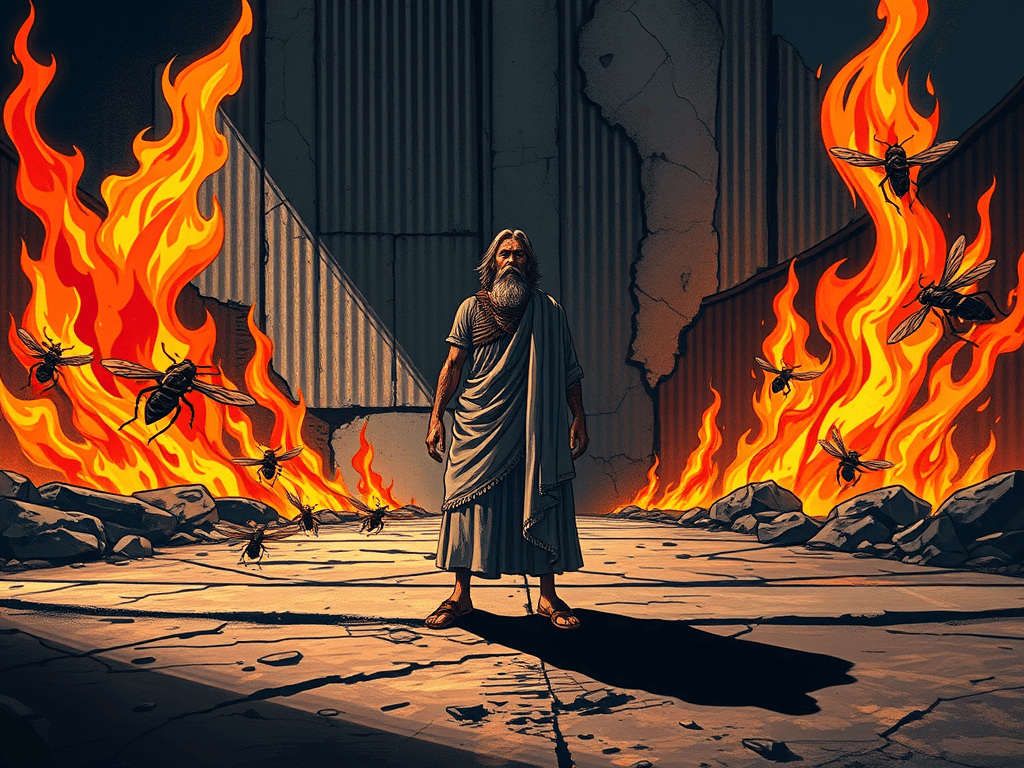
Yehovah shows Amos: “Look, the offspring of locusts is coming early, and look, one locust is Gag” (v. 1, LXX; “Gag” is Gog in Greek). The Masoretic Text (MT, e.g., ESV) describes: “He was forming locusts when the latter growth was just beginning to sprout… after the king’s mowings.” The LXX names the locust king as “Gog,” linking to Ezekiel 38-39’s Gog and Magog or Og of Bashan (Numbers 21:33; Deuteronomy 3:1), a giant king. The LXX sometimes translates “Og” as “Gog,” reflecting interchangeable terms.
Locusts symbolize destruction (e.g., Exodus plagues), but the king’s presence contradicts Proverbs 30:27: “The locusts have no king, yet all of them march in rank.” I point out this “Gog” as a divinely appointed destroyer, tying to Revelation 9:1-11, where locusts emerge from the abyss under Abaddon/Apollyon (“destruction”). These locusts harm the unsealed, mirroring Amos’s devouring swarm. Amos pleads: “Oh Yehovah, be merciful. Who will raise up Jacob, because he is very small?” (v. 2). Yehovah responds: “This will not be” (v. 3, LXX), affirming judgment’s inevitability, echoing Revelation’s unrepentant humanity despite signs.
Vision 2: Devouring Fire from the Depths
The second vision: “Yehovah invoked the judgment with fire… it devoured the great deeps and the portion of Yehovah” (v. 4, LXX). The MT says it “devoured the land” (ESV). The “great deeps” evoke Genesis 1:2 and 7:11’s chaotic waters or abyss, while Yehovah’s “portion” is Israel (Deuteronomy 32:9). The speaker connects this to Revelation’s fiery judgments and 1 Peter 4:17: “Judgment happens first in the household of God.”
Amos intercedes again: “Oh Yehovah, stop now… Who will raise up Jacob, because he is very small?” (v. 5). Yehovah declares: “This will not happen” (v. 6), refusing reprieve. This quotes Deuteronomy 32:21-22, where idolatry provokes God’s fiery anger burning to Sheol’s depths. Note this “grafting in” of a “foolish nation” (Gentiles) provokes jealousy, not by imitating Jewish traditions but by simply following God’s word: “We may not even know how to be real Israelites. We just know what His word says.”
Vision 3: The Weak Tin Wall
The third vision: “One was posted upon an adamantine wall, and adamant was in his hand” (v. 7, LXX). Yehovah asks: “What do you see, Amos?” Amos replies: “Adamant.” Yehovah declares: “I am placing adamant in the middle of my people Israel” (v. 8). The Hebrew anak was long translated as “plumb line” (MT, ESV), but Akkadian cognates reveal it means “tin” (anaku), a weak metal. The LXX’s “adamantine” transliterates the term, reflecting ancient uncertainty.
Tin symbolizes fragility: “Tin is… not strong… like tinfoil, easily knocked over.” Unlike Jeremiah’s “iron pillar” and “bronze walls” (Jeremiah 1:18-19), signifying divine protection, Israel’s “tin wall” exposes vulnerability. Yehovah withdraws: “No longer will I add to passing by him” (v. 8). The “altars of derision” (laughter, LXX) or “high places of Isaac” (MT) will be destroyed, along with Israel’s rituals. This ties “derision” to false joy in corrupt worship, like Jeroboam I’s unauthorized feasts (1 Kings 12:31-33). Yehovah promises to “arise against the house of Jeroboam with a sword” (v. 9), fulfilling judgment.
The speaker connects this to James 4:8-10: “Let your laughter be turned to mourning… Humble yourself before Yehovah.” Repentance preempts forced mourning, as Israel had time but refused.
Amaziah’s Confrontation: False Authority vs. True Calling
Amaziah, Bethel’s priest, reports Amos to King Jeroboam: “Amos is creating conspiracies… Jeroboam will die by a sword, and Israel will be led as captive” (v. 10-11). He commands Amos: “Oh seer, go… to the land of Judah… No longer increase prophesying in Bethel, for it is a sanctuary of the king” (v. 12-13). “Seer” implies a professional prophet-for-hire, but Amaziah prioritizes his title over truth: “He’s concerned about his priesthood… not the nation or the king.”
Amos retorts: “I was not a prophet, nor was I the son of a prophet. Rather, I was a goat herder and one who scratches mulberry fruits” (v. 14, LXX; MT: “sycamore figs”). Sycamore figs, inferior fruit for the poor, require gashing to ripen: “You actually have to cut into the sycamore fig… speeding the ripening process.” This symbolizes Amos’s “rough handling” of Israel’s sins, ripening them for judgment. As a herdsman with authority, Amos aligns with the oppressed (Amos 1-6): “I’m the people’s advocate because you are not doing your job.”
Amos prophesies against Amaziah: “Your wife will prostitute herself… your sons and daughters will fall by the sword… you will die in an impure land” (v. 17). Israel faces captivity, confirming the visions.
Textual Insights: LXX vs. MT
The LXX provides unique renderings:
- Gog as Locust King: Absent in MT, ties to Revelation’s Abaddon, suggesting spiritual dimensions.
- Great Deeps: LXX’s abyss-like “deeps” vs. MT’s “land,” evoking chaos and deeper judgment.
- Adamant as Tin: Reveals weakness, supported by Akkadian/Ugaritic contexts, contrasting MT’s “plumb line.”
These variants, informed by the biblical world, clarify ambiguities: “If you don’t understand the biblical world… you’ll never understand what’s really going on.”
Lessons: Repentance and True Advocacy
Amos 7 urges immediate repentance: “We have an opportunity right now to make things right… walk according to Your word, not false religions.” Amos, a humble worker, contrasts with Amaziah’s self-centered priesthood, challenging modern leaders prioritizing titles over truth. The visions warn of judgment on the unrepentant, echoing Revelation: “They see these things… yet they don’t repent.” Believers must reject pride, advocate for the oppressed, and follow God’s word simply, even if it looks “foolish” to others.
A Prayer for Readiness and Truth
Father, we come before You, thankful for Amos 7’s warnings. Help us hear Your urgent calls and repent while there’s time. We don’t know the day or hour, but today we choose Your ways over false ideas and priests. Guide us to walk in Your truth, little by little or in big leaps. Watch over Your people, send angels to guard us, and speak to us as You did to Amos. In Yeshua’s name, Amen.
 Word of Truth Fellowship
Leave a comment