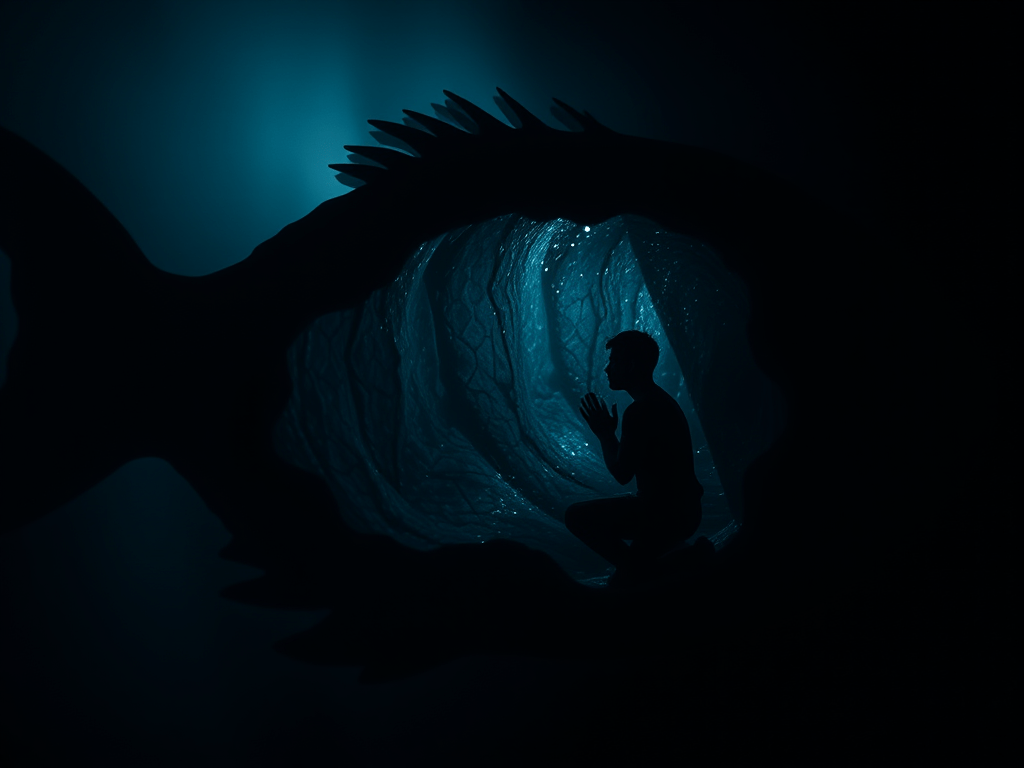
Welcome back to our series on the Book of Jonah! If you’ve been following along, we’ve already covered Chapter 1 and dipped into the beginning of Chapter 2. Today, we’re jumping right into this short but powerful chapter—just 10 verses (or 11, depending on how you count verse 1:17). We recently celebrated the new month, something I’ve wanted to incorporate for years. Back when we followed a strictly lunar calendar, it never quite worked out—life always got in the way. But since shifting to a understanding where the sun, moon, and stars align as signs (Genesis 1:14), we’ve celebrated every month without hindrance. For me, that’s a quiet confirmation we’re on the right path. Now, let’s dive in!
Why Jonah Chapter 2 Stirs Debate
Jonah 2 opens with an introduction in verse 1 (or 1:17 in some translations), followed by Jonah’s prayer from verses 2-9. Interestingly, some scholars argue this prayer doesn’t belong—it was added later or doesn’t fit the narrative. Skeptics even dismiss the entire book: a giant fish? A one-sentence sermon leading to mass repentance in Nineveh? But Scripture is full of miracles! Think Daniel in the lions’ den, Shadrach, Meshach, and Abednego in the fiery furnace, or Peter walking on water. Even Jesus’ first message was a one-liner: “Repent, for the kingdom of heaven is at hand” (Matthew 4:17).
This prayer mirrors other biblical songs of deliverance, like the Song of Moses in Exodus 15 (right after the Red Sea parting) or David’s lament after Saul’s death in 2 Samuel 1. These give us intimate, personal glimpses into pivotal moments. Jonah’s prayer does the same, offering a raw look at his despair and turnaround. Why the pushback? Perhaps because Jesus references Jonah as His sign (Matthew 12:39-40). Discredit Jonah, and you undermine the Messiah.
Breaking Down Jonah’s Prayer (Jonah 2:1-10)
Let’s read from the Lexham English Bible for clarity. Note: Many ancient texts (Septuagint, Syriac, Aramaic, Latin Vulgate) include 1:17 as part of Chapter 2, framing the chapter with the fish as “bookends.”
Jonah 1:17-2:10 (LEB)
And Yahweh appointed a great fish to swallow Jonah, and Jonah was in the belly of the fish three days and three nights. Then Jonah prayed to Yahweh his God from the belly of the fish and said,
“I called out to Yahweh from my distress, and he answered me; from the belly of Sheol I cried for help— you heard my voice. For you threw me into the deep, into the heart of the seas, and the sea currents surrounded me; all your breakers and your surging waves passed over me. And I said, ‘I am banished from your sight; how will I continue to look on your holy temple?’
The waters encompassed me up to my neck; the deep surrounded me; seaweed was wrapped around my head. I went down to the foundations of the mountains; the underworld—its bars were around me forever. But you brought up my life from the pit, O Yahweh my God. When my life was ebbing away from me, I remembered Yahweh, and my prayer came to you, to your holy temple.
Those who worship vain idols forsake their loyal love. But I, with a voice of thanksgiving, will sacrifice to you; I will fulfill what I have vowed. Deliverance belongs to Yahweh!”
And Yahweh spoke to the fish, and it vomited Jonah out on the dry land.
From the Depths: Jonah’s Descent and Cry
Jonah prays from the “belly of Sheol” (v. 2)—the grave, the lowest point imaginable. He doesn’t die, but he’s as good as dead, mirroring Yeshua’s three days in the heart of the earth. Thrown into the sea (the path he chose to flee God), Jonah credits God, not the sailors, for his plight (v. 3). The waves and breakers are God’s doing, overwhelming him.
In verse 4, he laments being “banished from your sight”—echoing how sins are cast into the sea’s depths (Micah 7:19). Some translations add hope (“yet I will look again”), but ancient texts like the Septuagint render it as a desperate question: “How will I…?” This fits the despair; Jonah feels utterly cut off.
Language here echoes Psalms and prophets:
- Psalm 18:4-6: Cords of death entangle, torrents assail, but God hears from His temple.
- Isaiah 5:14: Sheol enlarges its mouth to swallow, like a monster devouring Jerusalem.
Even “seaweed” (Hebrew: suf) in verse 5 might mean “reeds” or “abyss” (as in the Septuagint). It’s not shallow kelp—Jonah’s in the deep, foundations of the mountains (v. 6), barred in the underworld forever. This ties to biblical cosmology: earth above, waters and Sheol below.
The Turning Point: Remembering God
As life fades (v. 7), Jonah remembers Yahweh—his prayer reaches the holy temple. He contrasts idol-worshippers who forsake “loyal love” (hesed, God’s steadfast covenant faithfulness) with his own vow: thanksgiving, sacrifice, fulfillment (v. 9). This echoes the sailors’ response in Chapter 1 and Psalm 50:14-15: Offer thanks, call in trouble, and God delivers.
Strikingly, Jonah doesn’t explicitly repent. He acknowledges God, gives thanks, and vows obedience—but no “I’m sorry.” Some call this an “unrepentant prayer.” If the book ended at Chapter 3 (Jonah obeying), we’d assume repentance. But Chapter 4 shows Jonah’s lingering bitterness toward Nineveh. Hmm.
The Profound Declaration
Jonah’s climax: “Deliverance belongs to Yehovah!” (v. 9). This Hebrew root for deliverance (yeshuah) gives us names like Joshua, Isaiah, Hosea—and Jesus (Yeshua). It’s not just eternal salvation; it’s deliverance from today’s troubles, sickness, pain. God destroys death (a “thing” in ancient views, like Canaanite Mot swallowing life). Beautiful!
Then, God speaks—the fish vomits Jonah onto dry land (v. 10). Not “spit” or “release”—vomited, a harsh word. One scholar quipped the fish was disgusted by Jonah’s hypocrisy! But the point isn’t the fish (we don’t even know its species). Everyone fixates on it or the three days, missing the prayer sandwiched between.
The Structure of Jonah’s Psalm: A Visual Breakdown
Like many Psalms, Jonah 2 has a chiastic structure—mirroring elements building to a peak. Here’s my rendering:
- A: The Fish Swallows (1:17-2:1) – Yehovah appoints the fish; Jonah in the belly three days/nights.
- B: Cry from Distress (v. 2) – Called to Yehovah from Sheol; He answered.
- C: Cast into Deep (v. 3) – Thrown into heart of seas; breakers pass over.
- D: Banished from Sight (v. 4) – How to look on temple?
- E: Waters Encompass (v. 5) – Up to neck/soul; deep surrounds; weeds wrap head.
- F: Lowest Point – Bars of Underworld (v. 6a) – Down to mountain roots; bars forever.
- E1: Life Brought Up (v. 6b) – Yet You raised me from the pit.
- D1: Prayer to Temple (v. 7) – Life ebbing, remembered Yehovah; prayer reaches temple.
- C1: Forsake Idols (v. 8) – Worship vain idols, lose loyal love.
- B1: Vow of Thanksgiving (v. 9) – Sacrifice with thanks; fulfill vows. Deliverance to Yehovah!
- A1: Fish Vomits (v. 10) – Yehovah speaks; fish vomits Jonah on dry land.
The negatives (A-E) descend to Jonah’s lowest point which is the pivot (F: bars closed forever). This is the center of the psalm, the place where Yehovah meets him. Then, the lifting up: “Yet You brought up my life!” Ascent begins (E1-A1). Jonah spirals down choosing death, meets God at rock bottom, and rises. This mirrors our lives—and Yeshua’s sign: Repent before it’s too late, or face eternal bars. He is life (John 14:6), turning downward spirals upward.
Wrapping Up: A Blessing for the Journey
Pray this blesses you! Next time, we’ll tackle Chapter 3—Jonah finally obeys (spoiler: the story doesn’t end happily ever after). Father, thank You for Your Word, presence, grace, mercy, and truth. You meet us in our lowest places, even when we’re running. You’ve pulled me from dark depths; do the same for Your people. Remind them to call on You in distress—all who call on Yahweh will be saved from trouble, hurt, trials, pain. As Solomon heard: If My people humble themselves and pray, I will listen (2 Chronicles 7:14).
Yahweh bless you and keep you. Yahweh make His face shine upon you and be gracious to you. Yahweh lift up His countenance upon you and give you peace—in Yeshua’s name. Amen.
 Word of Truth Fellowship
Leave a comment